Buy Epithalon (25mg) Online
Epithalon, or Epitalon, is a small synthetic peptide that appears to activate the telomerase enzyme and may promote the release of melatonin. Experimental research has suggested its potential to slow alterations in reproductive and immune systems and improve life spans in mice and rats.[1] Apart from its potential in regulating cell aging, the peptide has also played an important role in research conducted on certain classes of cancer, infectious diseases, and DNA regulation.
Specifications
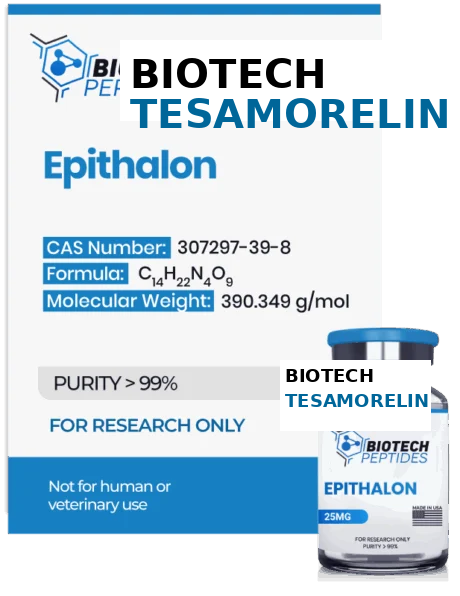
Molecular Formula: C14H22N4O9
Molecular Weight: 390.34 g/mol
Sequence: Ala-Glu-Asp-Gly
Other Known Titles: Epitalon, Epithalone, Epithalamin
Epithalon Research
Epithalon and Cell Aging
Early research on insect and murine models hypothesized that Epithalon may improve cell span to a significant extent.[2] More specifically, epithalamin, a related pineal peptide preparation containing Epithalon, has been suggested to potentially increase the mean lifespan of insect and murine models by 11–31%. Furthermore, the experiment in rats suggested a 52% decrease in mortality upon Epithalon exposure. It appears to have been impactful in mice models of cardiac disease, where the life expectancy was reported to be increased by 27% compared to control animals. The peptide has been observed to mediate action by eliminating free radicals (charged molecules that damage tissue). More specifically, this potential antioxidative action of the peptide may inhibit free radical processes in both murine and insect models, and it is suggested that these antioxidative properties may potentially lead to increased lifespan in other test models. Apart from studies focused on its antioxidant activity, Epithalon has also been studied for its potential to activate an enzyme called telomerase in cell culture assays. Telomerase is considered to preserve the ends of chromosomes, known as telomeres, which are deemed crucial for maintaining the integrity of DNA. Epithalon may potentially preserve the DNA from damage by activating the telomerase and decreasing the number of errors in the DNA strands. This dual potential of enhancing antioxidant defense and possibly boosting telomere integrity might explain some of the lifespan-extending actions hypothesized in epithalamin and Epithalon models.
Another study posited that Epithalon might reduce intracellular reactive oxygen species (ROS) in aged oocyte cells, suggesting antioxidative characteristics.[3] Specifically, Epithalon appeared to decrease ROS accumulation significantly compared to higher concentrations, which did not yield the same protective action. This reduction in ROS might be crucial, as oxidative stress is considered a key factor in cellular aging. Epithalon also potentially preserves oocyte structural integrity. It was observed to decrease fragmentation rates in post-ovulatory aged oocytes and during parthenogenetic activation. Fragmentation, indicative of compromised cytoplasmic integrity, was notably reduced in the 0.1mM Epithalon group, implying a protective action on cellular morphology. Additionally, Epithalon appeared to maintain spindle integrity and proper cortical granule (CG) distribution. Spindle abnormalities, common in aged oocytes, appeared to have been mitigated by Epithalon, as was the mislocalization of CGs, which are essential for fertilization. These findings suggest that epithalons may help preserve the cytoskeletal and cortical structure of oocytes during aging. Mitochondrial function, a critical aspect of oocyte viability, appeared to be also positively affected by Epithalon. The study reported higher mitochondrial membrane potential and increased mtDNA copy numbers in Epithalon-exposed oocytes. Given that mitochondria are pivotal in ATP production and cellular energy metabolism, these findings propose that Epithalon may support mitochondrial integrity and functionality during oocyte aging. Furthermore, Epithalon experimentation seemed to reduce DNA damage and apoptosis in aged oocytes. The peptide decreased the fluorescence intensity of γH2AX signals, a marker of DNA damage, and appeared to have lowered apoptosis rates as indicated by Annexin-V staining. This implies that Epithalon might enhance oocyte survival by mitigating oxidative damage and preserving genomic stability.
Be the first to review “Epithalon (25mg)”
Related products
Peptides
Peptides
Peptides
Peptides
Peptides
Peptides
Peptides
Peptides
Reviews
There are no reviews yet.