
Buy GHK-CU (Copper) (50mg) Online
Buy GHK-CU (Copper) (50mg) Online. GHK-Cu is a naturally occurring peptide that was first purified from blood plasma, though its traces have also been identified in both saliva and urine. Experimental research in GHK-Cu indicates the peptide may host the potential to impact tissue repair and affect certain immunological functions.[1] The peptide has been studied for its potential in mitigating cell aging, inducing protein synthesis, minimizing free-radical damage, preventing bacterial infection, and improving the function of skin fibroblasts. Research in this multifaceted peptide is still ongoing.
Specifications
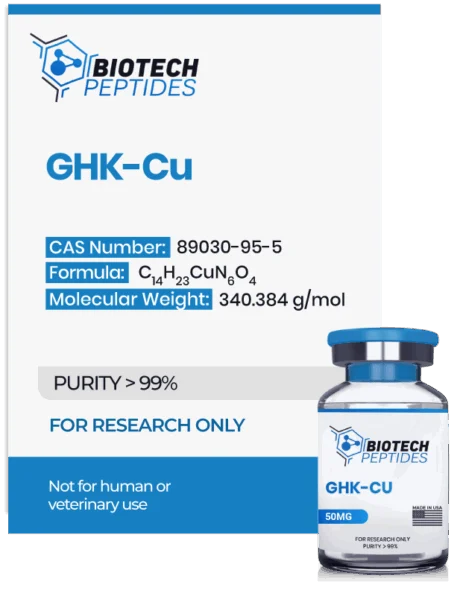
Molecular Formula: C14H23CuN6O4
Molecular Weight: 340.38 g/mol
Sequence: Gly-His-LysCu.xHAc
GHK-Cu Research
GHK-Cu and Skin Cells
GHK-Cu is a natural component of blood and has been studied for its potential impact on dermal regeneration pathways. Research in skin cultures has suggested that GHK may stimulate the synthesis as well as the breaking down of collagen, glycosaminoglycans, and other components of the skin’s extracellular matrix like proteoglycans and chondroitin sulfate. This potential appears to be partially mediated through the positive action of GHK-Cu recruitment on fibroblasts, endothelial cells, and immune cells. The peptide appears to attract these cells to the wound site and coordinates their activity in repairing the damage. The peptide has also been researched for its potential modulation of collagen synthesis. Research in the roles of GHK-Cu suggests its actions may be mediated partially via an expression of transforming growth factor Beta. It is likely that the peptide works through various biochemical pathways and may modify gene expression. Studies in mice suggest that GHK-Cu may increase the rate of wound healing in burns by as much as 33%.[1] The peptide appears to recruit immune cells and fibroblasts to sites of injury and may promote the development of new blood vessels at these sites.
GHK-Cu and Cognitive, Nervous System Functions
The mechanism behind neuronal death, which occurs in degenerative diseases such as Alzheimer’s, is poorly understood. Studies have suggested GHK-Cu’s potential to inhibit loss in neuronal function, which has been associated with such diseases.[2] In these studies, the molecule has been observed to enhance angiogenesis in the nervous system, to potentially stimulate nerve outgrowth, and decrease inflammation in the central nervous system. Further scientific studies support the theory that it may alter the expression profiles of pathological genes and help reset a state of controlled function in dysfunctional systems. Natural GHK-Cu expression is considered to naturally decrease. Some scientists believe that GHK-Cu may possibly exert neuroprotective action against natural insults like gene dysregulation. The peptide has been suggested to protect neurons in rat brains from apoptosis through the well-known miR-339-59/VEGFA pathway, which is considered to become active after brain bleeds and stroke. In the rat models, GHK-Cu was reported to improve the neurological deficits in the brain, reducing swelling and preventing neuronal death associated with over-expression of miR-339-5p.
GHK-Cu and Bacteria
GHK-Cu, in combination with certain fatty acids, may create a potentially antimicrobial compound acting against bacteria and fungi that is considered to interfere with tissue repair processes. Diabetes research has suggested that GHK-Cu may exert such action, with findings reporting a combination of standard procedure and GHK-Cu to induce a 40% increase in wound closure and a 27% reduction in infection rates as opposed to control groups.[3] Similar results have also been noted from studies in ischemic wounds. Researchers report that “GHK-Cu improved healing of ischemic wounds and suppresses inflammation by lowering the level of acute-phase inflammatory cytokines such as TGF-beta and TNF-alpha.”
GHK-Cu and Lungs
Studies in murine models have suggested that GHK-Cu may protect the lungs against fibrosis.[4] The study has also explored the mechanistic action of the peptide. It was observed to modulate TNF-alpha and IL-6 levels, both of which are considered to function as inflammatory molecules and may affect the extracellular matrix and smooth muscles of the lungs. The peptide may reduce lung inflammation, thereby enhancing collagen production and preventing fibrotic remodeling. GHK-Cu was also suggested to be effective in murine research models of acute respiratory distress syndrome (ARDS). This inflammatory lung condition may become aggravated very fast and may be fatal. ARDS is linked with injury and infection. Once again, the suggested underlying mechanism of the peptide action is decreasing the expression of TNF-alpha and IL
Be the first to review “GHK-CU (Copper) (50mg)”
Related products
Peptides
Peptides
Peptides
Peptides
Peptides
Peptides
Peptides
Peptides
Reviews
There are no reviews yet.