
Buy Mod GRF 1-29 & GHRP-6 (10mg) Online
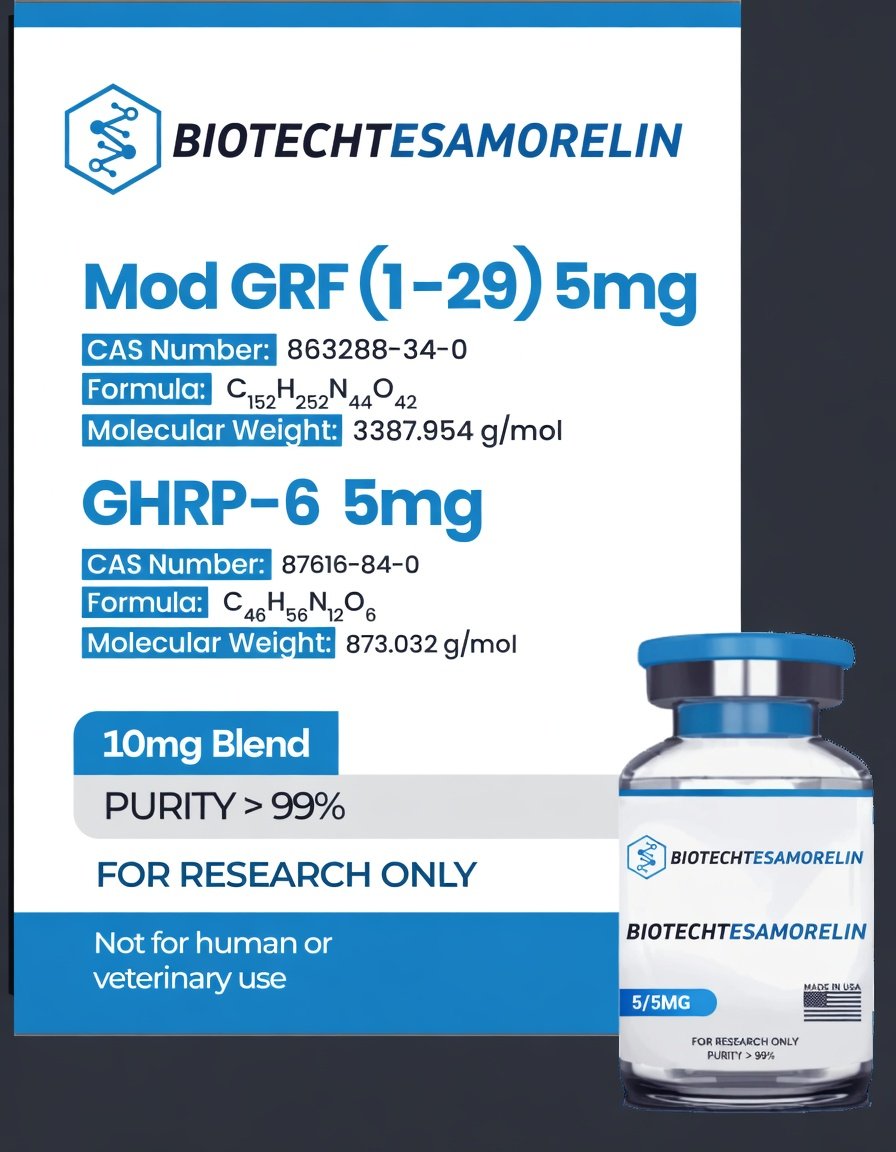
Buy Mod GRF 1-29 & GHRP-6 (10mg) Online. Modified Growth Hormone Releasing Factor (Mod GRF 1-29) and Growth Hormone Releasing Peptide-6 (GHRP-6) are two peptides that researchers believe may support the secretion of growth hormone (GH) from cells in the anterior pituitary gland. The peptides may offer this support through distinct biological pathways. Mod GRF (1-29) is a synthetic peptide derived from Growth Hormone Releasing Hormone (GHRH), an endogenous hormone consisting of 44 amino acids that stimulates GH release. Some studies have indicated that the initial 29 amino acids of GHRH retain their full biological activity.[1] Modifications to this fragment, resulting in Mod GRF (1-29), are believed to increase its potency and prolong its duration of action, possibly due to better-supported stability against enzymatic degradation.
In contrast, GHRP-6 is a synthetic hexapeptide structurally related to met-enkephalins. Met-enkephalins are endogenous peptides involved in interacting with opioid receptors.[2] GHRP-6 does not interact with opioid receptors. Rather, GHRP-6 is thought to stimulate GH release by activating ghrelin receptors in the pituitary cells. These receptors are also referred to as growth hormone secretagogue receptors, and thus, GHRP-6 is defined as a growth hormone secretagogue (GHS) peptide. These hypothetical actions of GHRP-6 suggest a mechanism different from that of GHRH analogs like Mod GRF (1-29). Because Mod GRF (1-29) and GHRP-6 are believed to operate through separate receptors and signaling pathways, there is a possibility that their combined implications as a blend might produce synergistic action on GH secretion in experimental settings.
Modified GRF (1-29) Specifications
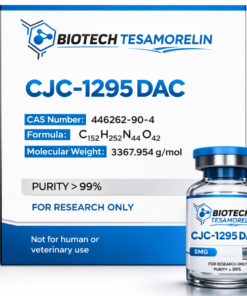
MOLECULAR FORMULA: C152H252N44O42
MOLECULAR WEIGHT: 3367.95 g/mol
SEQUENCE: H-Tyr-D-Ala-Asp-Ala-Ile-Phe-Thr-Gln-Ser-Tyr-Arg-Lys-Val-Leu-Ala-Gln-Leu-Ser-Ala-Arg-Lys-Leu-Leu-Gln-Asp-Ile-Leu-Ser-Arg-NH2
GHRP-6 Specifications
MOLECULAR FORMULA: C46H56N12O6
MOLECULAR WEIGHT: 873.032 g/mol
SEQUENCE: L-histidyl-D-tryptophyl-L-alanyl-L-tryptophyl-D-phenylalanyl-L-lysergamide, triacetate
Mod GRF (1-29) & GHRP-6 Research
Mod GRF (1-29) & GHRP-6 Peptides and Pituitary Cell Receptors
Researchers have proposed that Mod GRF (1-29) and GHRP-6 may contribute to the elevation of various growth hormones and, consequently, insulin-like growth factor-1 (IGF-1) levels. This is thought to occur through the potential activation of specific receptors associated with these hormones. Mod GRF (1-29) is thought to interact with growth hormone-releasing hormone receptors. These receptors are located on somatotroph cells in the anterior pituitary gland, which is a region at the base of the brain. Upon binding to the receptors, scientists believe that Mod GRF (1-29) may trigger a cascade of intracellular signaling pathways that facilitate this process.[3] One such signaling pathway that Mod GRF (1-29) is believed to activate involves adenylyl cyclase. Adenylyl cyclase is an enzyme that converts adenosine triphosphate (ATP) into cyclic adenosine monophosphate (cAMP).
Be the first to review “Mod GRF 1-29 & GHRP-6 (10mg)”
Related products
Peptides
Peptides
Peptides
Peptides
Peptides
Peptides
Peptides
Peptides
Reviews
There are no reviews yet.